
Lapland offers a virtually guaranteed white Christmas, making it the most reliably snowy region in Europe during the festive season. Finnish Lapland sits well above the Arctic Circle, where winter snowfall typically begins in October and the ground stays covered continuously through December and beyond. The sections below explore exactly why Lapland’s Christmas snow is so dependable, how it compares to the rest of Europe, and what the experience of being there actually feels like.
How much snow does Lapland typically have at Christmas?
By Christmas, Finnish Lapland typically has between 40 and 80 centimetres of snow on the ground, with some northern areas accumulating even more. Snow usually arrives in earnest in October and builds steadily through November, so by the time December 25th comes around, the landscape has been a deep, unbroken white for weeks. The snowpack is not a dusting — it is a full Arctic winter.
The snow in Lapland at Christmas is also of a particular quality that surprises many first-time visitors. Because temperatures regularly drop to between minus 10 and minus 25 degrees Celsius during December, the snow stays dry, light, and powdery rather than the wet, slushy variety common further south. This means it clings to pine branches, settles on rooftops, and creates that storybook winter landscape that most of Europe can only dream of.
In the Saariselkä area of northern Finnish Lapland, where we are based at Aurora Queen Resort, the snow depth at Christmas is consistently substantial. The fells and forests surrounding the resort are blanketed in white, and the nights are long and dark — ideal conditions not only for a white Christmas but also for witnessing the Northern Lights.
What makes Lapland’s climate so reliably snowy in winter?
Lapland’s reliable winter snow comes down to its geography and latitude. Finnish Lapland sits between roughly 66 and 70 degrees north, placing much of it above or near the Arctic Circle. At this latitude, winter temperatures drop early and stay consistently low for months, preventing any thaw that might melt accumulated snow. The combination of cold, dry continental air from the east and the region’s distance from the warming influence of the Atlantic Ocean locks in winter conditions from autumn through spring.
Several factors work together to make Lapland’s winter snowfall so consistent:
- Sustained sub-zero temperatures: Once snow falls in October or November, temperatures rarely rise above freezing again until March or April, so the snowpack simply accumulates rather than melting and refreezing.
- Continental climate influence: Unlike coastal Scandinavia, which is moderated by the sea, Finnish Lapland experiences a more continental climate with colder, drier winters and less variability.
- Polar night: From late November, parts of northern Lapland experience kaamos, the polar night, where the sun does not rise above the horizon at all. Without solar radiation to warm the ground, temperatures stay consistently low and snow is preserved.
- Topography: The open fells and dense boreal forests of Lapland trap and hold snow effectively, with forested areas in particular accumulating impressive snowpacks that shelter the ground from wind erosion.
This combination of factors is what separates Lapland from the rest of Europe. It is not simply that it snows more — it is that the conditions are structured to keep that snow in place throughout the entire winter season.
Which parts of Europe have the lowest chance of a white Christmas?
The vast majority of Western and Central Europe has a low to very low chance of a white Christmas. Cities like London, Paris, Amsterdam, and Madrid rarely see snow on December 25th, and when they do, it tends to be a brief and unreliable dusting rather than a settled snowpack. Even traditionally colder cities like Berlin or Warsaw see a white Christmas only in certain years, with no consistency.
The reasons vary by region. Western Europe is strongly influenced by the Atlantic Ocean, which keeps winters mild and wet rather than cold and snowy. Southern Europe is even less likely to see Christmas snow at lower elevations, with Mediterranean climates producing mild, rainy winters across countries like Italy, Spain, and Greece. The British Isles sit in a particularly challenging climatic position, where mild Atlantic air masses dominate, and a true white Christmas in major cities is genuinely rare.
Even within Scandinavia, the picture is uneven. Oslo and Stockholm, despite their northern reputations, sit at latitudes comparable to parts of Alaska but are warmed considerably by proximity to the sea. Their Christmases can be grey and rainy rather than white in some years. Copenhagen, Helsinki, and other Scandinavian capitals have better odds than Western Europe but still cannot match the reliability of Lapland further north.
The further north and further from the Atlantic you travel, the more dependable a white Christmas becomes. Finnish Lapland represents the extreme end of that spectrum within Europe.
Does Finnish Lapland ever miss a white Christmas?
Finnish Lapland missing a white Christmas is extraordinarily rare. Meteorological records consistently show that the northern parts of Finland, particularly above the Arctic Circle, have near-100% reliability for snow cover on December 25th. In the Saariselkä region and surrounding areas, a snowless Christmas would be genuinely exceptional and is not something that living memory or recent climate records can point to with any regularity.
Climate change has introduced more variability into Lapland’s winters in recent decades, with some years bringing warmer spells or unusual rain events even in the north. However, the fundamental climate structure of the region means that even in warmer-than-average winters, temperatures in northern Finnish Lapland remain well below freezing throughout December. The snowpack may vary in depth from year to year, but the ground being covered at Christmas is essentially a certainty.
This is a meaningful distinction from almost anywhere else in Europe. When travellers ask whether they are guaranteed a white Christmas in Lapland, the honest answer is: as close to guaranteed as weather ever gets. The region’s position above the Arctic Circle, combined with its continental climate, makes Christmas snow not a hopeful possibility but a reliable expectation.
What is it actually like to spend Christmas in Lapland?
Spending Christmas in Lapland is an experience that engages all the senses in ways that are difficult to replicate anywhere else in Europe. The days are short — in northern Lapland, December daylight lasts only a couple of hours at most — but this creates a particular kind of magic. The landscape glows in soft blue and pink twilight for much of the day, the snow muffles sound, and the air is crisp and clean in a way that feels genuinely different from city winters.
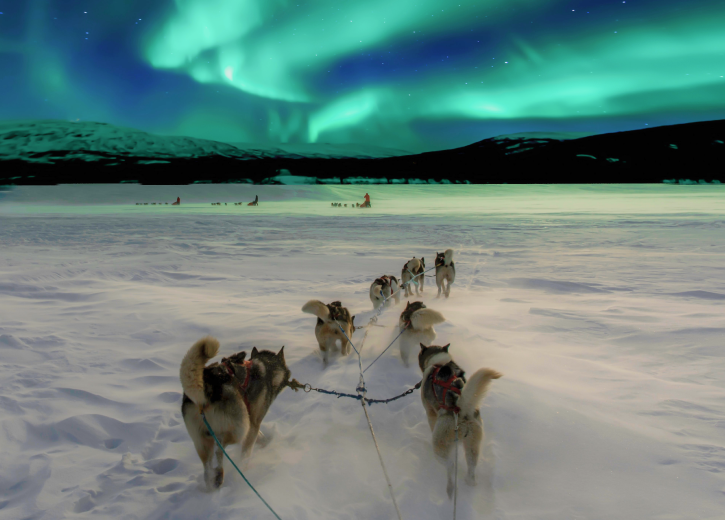
The darkness that might sound daunting is actually one of the most compelling aspects of a Lapland Christmas. Long, clear nights mean extended opportunities to see the Northern Lights, which are active throughout December. Standing under a sky filled with dancing green and violet light, surrounded by snow-covered fells and silent forest, is the kind of moment that reorients your sense of what a special occasion can feel like.
Practically, a Lapland Christmas involves layering up and embracing the outdoors. Activities like husky safaris, reindeer sleigh rides, snowmobile excursions, and ice fishing are all fully operational during the Christmas period, and many visitors find that the festive season adds an extra warmth to these experiences. Reindeer farms take on a particular meaning at Christmas, and the wildlife of the region — including the fox, which can sometimes be spotted moving silently across the snow at dusk — adds to the sense of being somewhere genuinely wild.
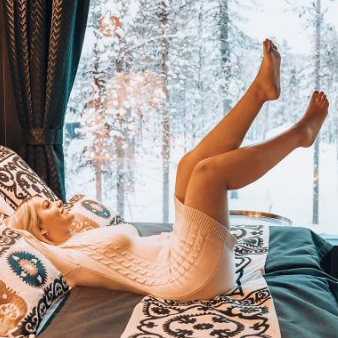
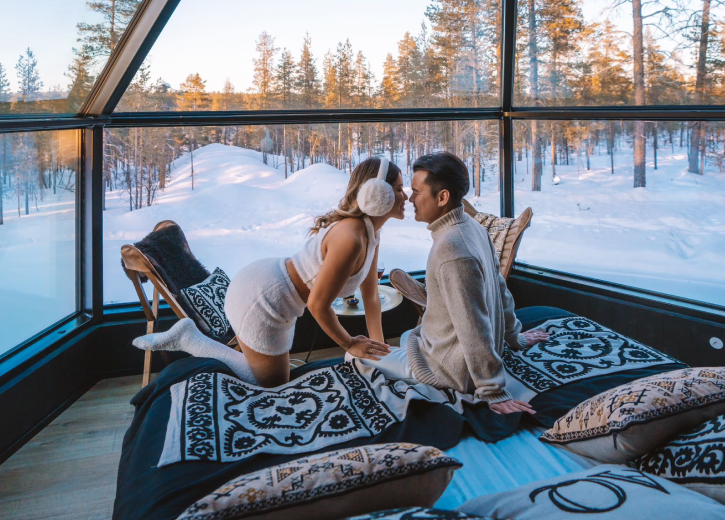
Indoors, the contrast is equally striking. Staying in a glass igloo during the Christmas period means waking up to snow-covered wilderness visible through panorama windows, watching the Northern Lights from the warmth of your bed, and experiencing the kind of stillness and peace that the festive season rarely offers in busier destinations. At Aurora Queen Resort, our Nordic restaurant serves seasonal menus rooted in locally sourced Lapland ingredients, which grounds the experience in the place itself rather than a generic holiday setting.
For those who have always associated Christmas with snow but have rarely experienced a truly white one, Finnish Lapland is not just a destination — it is the answer to what Christmas is supposed to feel like.