
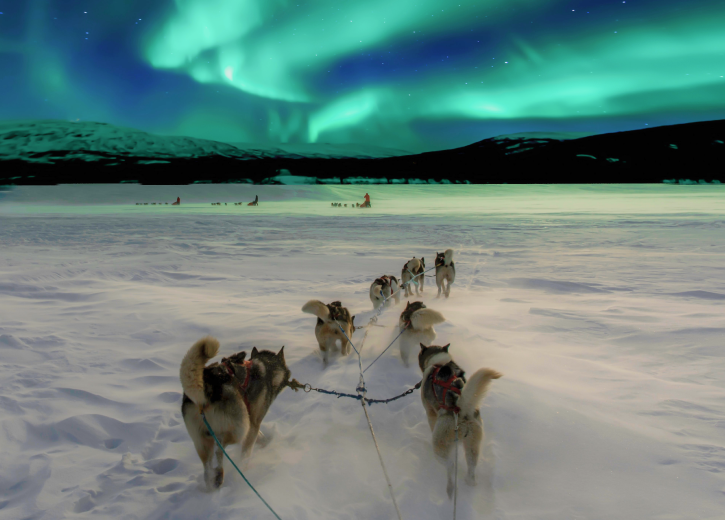
Northern lights are green because excited oxygen atoms release green light at roughly 100 to 150 kilometers above Earth, where the sun’s charged particles collide with the atmosphere most often. Red and purple appear when the same collisions happen at much higher or lower altitudes, or involve nitrogen, usually during strong geomagnetic storms. Below, we explain how gases, height, and solar activity shape every shade of the aurora borealis.
Which gases create each aurora color?
Oxygen and nitrogen create the aurora colors. Oxygen produces green and red light, while nitrogen produces blue and purple or pink hues. When charged particles from the sun strike these gases, the atoms and molecules gain energy and then release it as visible light of a specific color.
Each gas has its own “signature” wavelength, much like the glowing gas inside a neon sign. Here is how the main colors break down:
- Green: atomic oxygen at lower altitudes
- Red: atomic oxygen at very high altitudes
- Blue: ionized molecular nitrogen
- Purple, violet, and pink: a blend of nitrogen’s blue and red emissions, often seen at the lower edges of the curtains
The colors you see are also a mix. A display that looks pale pink or lilac to the eye is often several emissions layered together, which is why aurora colors can shift from minute to minute.
Why does altitude change the color of the aurora?
Altitude changes aurora color because the atmosphere’s composition and density shift with height. Oxygen dominates higher up, but the air there is so thin that excited atoms have time to emit slow red light. Lower down, denser air and more nitrogen produce green, blue, and purple.
Two things work together here. First, the type of gas available changes as you climb. Second, air density controls how quickly an excited atom must release its energy. Red emission from oxygen is a slow process, taking around two minutes. In denser air, atoms collide with other particles long before they can emit red light, so the energy is lost or released as faster green light instead.
This is why auroras often look layered. A typical display may show a bright green band in the middle, a violet or pink fringe along the lower edge, and a faint red glow high above. Solar particles with more energy can also dive deeper into the atmosphere, which brings nitrogen’s blue and purple tones into play.
Why is green the most common aurora color?
Green is the most common aurora color because oxygen at around 100 to 150 kilometers emits it quickly, and the particles that cause most auroras deposit their energy at exactly that height. Human eyes are also most sensitive to green light, so it looks brighter than other colors.
Two factors combine to make green dominant. The first is physical: green emission from oxygen happens in a fraction of a second, so it works efficiently even in moderately dense air. The second is biological. Our eyes, especially in low light, respond best to wavelengths near green. A faint red or blue glow that a camera records clearly may look gray or colorless to the naked eye, while the same intensity of green is easy to see.
That means the green you spot with your own eyes is a very reliable sign of a genuine aurora, even on quiet nights. Camera sensors, by contrast, often reveal extra pinks and purples that the eye misses.
What causes red or purple auroras during strong storms?
Red and purple auroras appear during strong geomagnetic storms, when the sun sends unusually energetic particles toward Earth. Intense activity excites oxygen at very high altitudes, producing red, and pushes particles deeper into the atmosphere, where nitrogen creates purple and violet edges.
When a powerful solar eruption reaches Earth, the aurora does not just get brighter; it gets taller and more varied. Particles reach a wider range of altitudes, so more layers of the atmosphere light up at once. Tall red tops above green curtains are a classic sign of a strong storm, and they can sometimes be seen even from places far south of the usual aurora zone.
Purple and pink often show up along the lower hem of fast-moving curtains, when energetic particles penetrate into the nitrogen-rich air below the green layer. These shades tend to appear briefly during the most active moments, sometimes called substorms, when the whole sky seems to ripple and pulse. Solar activity follows an eleven-year cycle, and the years around its peak, which include the mid-2020s, offer a better chance of these rarer colors.
When and where can you see colorful northern lights in Lapland?
You can see colorful northern lights in Lapland from late August to early April, on clear, dark nights away from city lights. Saariselkä, in Finnish Lapland, is an excellent location because its northern position and low light pollution give wide-open skies where subtle reds and purples can show up.
A few conditions raise your chances of seeing more than plain green:
- Dark, clear skies: cloud cover and artificial light hide the faintest colors.
- Strong solar activity: higher forecast levels often bring red tops and purple fringes.
- Time of night: the hours around local midnight are often the most active.
- Several nights of patience: every evening is different, so a longer stay improves your odds.
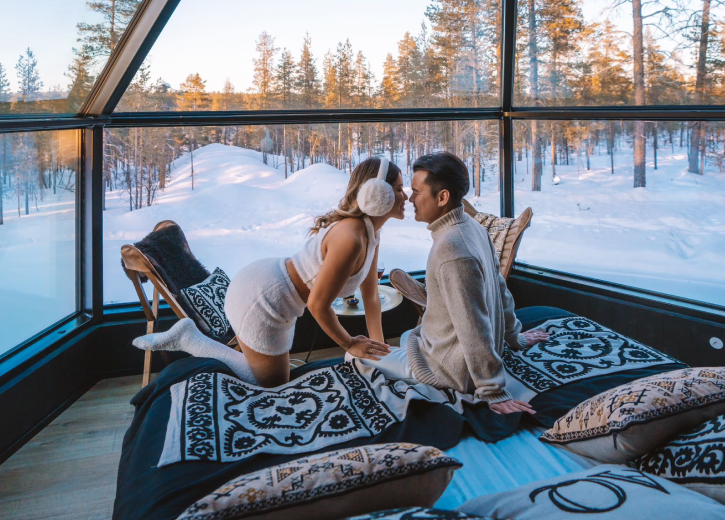
At our resort in Saariselkä, our glass-ceiling igloos let guests watch the sky from bed, so they can catch the changing colors without stepping into the cold. We are located far from light pollution, with open northern views, and we use geothermal heating and solid wood to keep the surroundings calm and quiet.
If you want to go out and chase the lights, our Northern Lights Adventure by Minivan is a comfortable way to do it. This three-hour evening tour starts at 175 euros per person, with a minimum charge for two people. Our guides check the latest aurora and cloud forecasts and choose the most promising night of your stay, then explore the dark skies with you from inside a warm minivan. As with any aurora experience, sightings cannot be guaranteed, but experienced guides and good forecasting make a real difference for your stay.
Whether the sky turns soft green or flashes red and violet, the colors you see are a direct view of physics at work in the upper atmosphere, and each display is a little different from the last.