
Cross-country skiing in Lapland is suitable for all skill levels, including complete beginners. The terrain around destinations like Saariselkä offers a wide range of trails, from flat beginner loops to more demanding routes for experienced skiers. Whether you have never put on skis before or you are a seasoned Nordic skier, Finnish Lapland has something to offer you. This article covers everything you need to know before heading out onto the trails.
Can complete beginners go cross-country skiing in Lapland?
Yes, complete beginners can absolutely go cross-country skiing in Lapland. The region has well-maintained, clearly marked beginner trails that are relatively flat and wide, making them ideal for first-timers. Equipment rental and guided introductory sessions are widely available, so you do not need any prior experience or your own gear to get started.
One of the great things about cross-country skiing, or Nordic skiing as it is sometimes called, is that the basic technique is more intuitive than downhill skiing. You are essentially walking and gliding rather than managing steep descents and sharp turns. Most beginners feel comfortable on easy terrain within an hour or two of their first attempt.
That said, it is worth being honest with yourself about your fitness level. Cross-country skiing is a full-body workout, and even gentle trails will engage your legs, core, and arms. If you are reasonably active in daily life, you will adapt quickly. If you are less active, starting with shorter loops and building up gradually is the sensible approach.
Guided beginner excursions are a particularly good option for first-timers. A knowledgeable local guide will teach you the basic stride and pole technique, help you choose appropriate trails, and make sure you stay safe and comfortable throughout. At Aurora Queen Resort, cross-country skiing and other winter activities are among the experiences we offer, giving guests a gentle and well-supported introduction to one of Finland’s most beloved winter traditions.
What are the different skill levels for cross-country skiing?
Cross-country skiing skill levels are generally divided into three broad categories: beginner, intermediate, and advanced. Understanding where you fall on this spectrum helps you choose the right trails, technique, and pace, so your time on the snow is enjoyable rather than exhausting or frustrating.
Beginner
Beginner skiers are those with little or no previous experience on cross-country skis. At this level, the focus is on balance, the basic diagonal stride, and learning to use poles effectively. Beginners are best suited to flat or gently rolling groomed trails, typically under five kilometres in length. Classic-style skiing on prepared tracks is the easiest starting point and is what most beginner routes in Lapland are designed for.
Intermediate
Intermediate skiers are comfortable on groomed trails and can handle moderate inclines and gentle descents with confidence. At this level, you may start exploring longer routes, experimenting with the skate skiing technique, and tackling trails with more varied terrain. Intermediate skiers can typically cover ten to twenty kilometres without difficulty and begin to develop a more efficient and rhythmic technique.
Advanced
Advanced skiers have strong technique in both classic and skate styles, are comfortable on steep or uneven terrain, and can cover long distances in variable snow conditions. At this level, off-piste wilderness skiing becomes possible, which opens up the more remote and spectacular parts of the Lapland landscape. Advanced skiers often seek out multi-day routes or backcountry trails that take them far from groomed networks.
How is cross-country skiing in Lapland different from skiing elsewhere?
Cross-country skiing in Lapland is distinct from skiing in most other destinations because of its combination of wilderness scale, snow quality, and cultural depth. Finnish Lapland offers vast, largely uninhabited landscapes where groomed trail networks extend for hundreds of kilometres, often passing through ancient forests, frozen lakes, and open fells with no sign of human development in any direction.
The snow conditions in Finnish Lapland are particularly well suited to Nordic skiing. Temperatures are consistently cold throughout the winter season, which means the snow stays dry and powdery rather than wet and heavy. This makes gliding easier and the overall experience more pleasant, especially for beginners who are still developing their technique.
The cultural dimension also sets Lapland apart. Cross-country skiing is not just a sport here; it is woven into everyday life. Locals use skis to commute, explore, and connect with the land in a way that feels entirely natural. Skiing through a quiet forest at dusk, with the only sounds being the soft hiss of your skis and the occasional call of a bird, is an experience that is difficult to replicate anywhere else in the world.
Another distinguishing factor is the darkness and light. In midwinter, Lapland experiences polar night, meaning the sun does not rise above the horizon for several weeks. Many trails are lit by lanterns or headlamps, and skiing under a sky full of stars or, with luck, the Northern Lights, is one of those experiences that stays with you long after you return home. In spring, the opposite is true: the midnight sun means you can ski at any hour of the day or night.
What should you wear and bring for cross-country skiing in Lapland?
For cross-country skiing in Lapland, layering is the single most important principle. Temperatures can drop well below minus twenty degrees Celsius, but the physical effort of skiing generates significant body heat, so you need clothing that insulates when you are resting and breathes when you are moving. Getting this balance right makes the difference between a comfortable outing and a miserable one.
Clothing layers
Start with a moisture-wicking base layer that pulls sweat away from your skin. Merino wool or synthetic thermal fabrics work well. Over this, add a mid-layer for insulation, such as a fleece or light down jacket. Your outer layer should be windproof and water-resistant but not necessarily fully waterproof, as fully sealed shells can trap moisture from perspiration. For your legs, thermal tights or softshell trousers are preferable to heavy waterproof trousers, which restrict movement. Wool socks, warm gloves or mittens, and a hat that covers your ears are essential.
Equipment and accessories
If you are renting equipment, the rental provider will typically fit you with skis, boots, and poles appropriate for your height and weight. Bring sunglasses or ski goggles to protect your eyes from glare, particularly in spring when the sun reflects strongly off the snow. A small daypack is useful for carrying water, a snack, a spare layer, and a fully charged phone. Even on short trails, it is wise to carry a map or have the trail downloaded on your phone in case you lose the marked route.
Sunscreen is often overlooked in winter but is genuinely necessary in Lapland, especially from February onwards when the sun is low but the UV reflection from snow is strong. Lip balm and hand cream will also help protect your skin against the dry, cold air.
When is the best time to go cross-country skiing in Lapland?
The best time for cross-country skiing in Lapland is from late November through to April, with the peak season running from January to March. Snow cover is reliable throughout this period, daylight hours are increasing after the winter solstice, and trail conditions are at their best. For most visitors, February and March offer the ideal combination of good snow, reasonable daylight, and manageable temperatures.
Early season skiing, from late November into December, can be magical, particularly around the festive period when the landscape is at its most atmospheric. However, daylight is extremely limited during this time, with only a few hours of dim twilight in the darkest weeks. Trails may also be less well-groomed early in the season as the snowpack builds.
January is excellent for those who want to experience the deep Lapland winter in its most dramatic form. Days are short but growing longer, and the snow is typically abundant and in fine condition. The cold can be intense, but with the right clothing, this is entirely manageable and part of what makes the experience so memorable.
March and April are arguably the most comfortable months for active skiing. Daylight has returned in full, temperatures are milder, and the snow is still deep and well-packed on most trails. Spring skiing under a bright blue sky, with the sun warming your face while the ground remains firmly frozen beneath your skis, is a uniquely satisfying experience. In Saariselkä, the ski season often extends well into April, making it one of the longer reliable windows for Nordic skiing in Lapland.
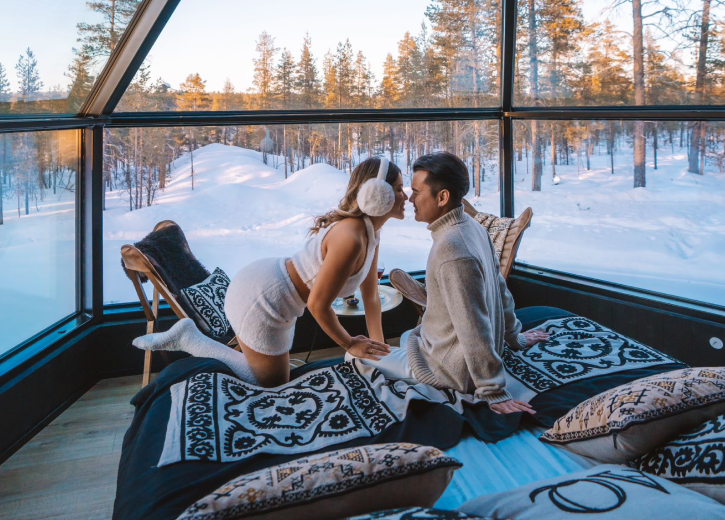
Whatever time of year you visit, pairing your days on the trails with evenings spent watching the sky from a warm, comfortable base makes the experience complete. The combination of physical activity in the Arctic outdoors and the quiet luxury of a glass igloo under the night sky is one of the most restorative ways to spend a winter holiday in Finnish Lapland.