

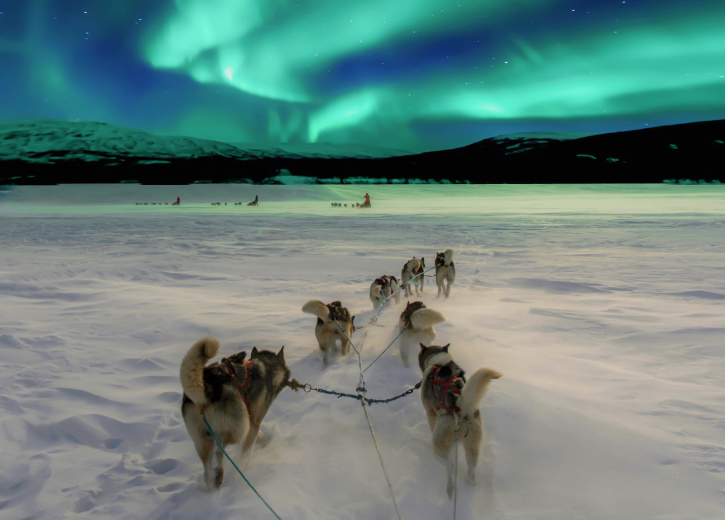
The Northern Lights, also known as the aurora borealis, are natural light displays that occur when charged particles from the Sun interact with Earth’s magnetic field and atmosphere. These particles collide with gas molecules in the upper atmosphere, creating brilliant curtains of green, pink, red, and purple light that dance across polar skies, typically visible between 65 and 72 degrees north latitude.
Unpredictable aurora activity is ruining your Northern Lights viewing plans
Many travelers plan expensive trips to see the Northern Lights without realizing that aurora activity follows an 11-year solar cycle and can vary dramatically from night to night. You might spend thousands on accommodations and flights only to arrive during a solar minimum or a stretch of cloudy weather that blocks visibility for your entire stay. The solution is to time your visit for peak aurora season (September through March) and stay flexible, with multiple viewing opportunities rather than relying on a single night.
Poor location choices are blocking your aurora experience
Choosing accommodations in cities or areas with significant light pollution severely reduces your chances of witnessing the full spectacle of the Northern Lights. Urban glow washes out fainter aurora colors and limits visibility to only the strongest displays. Choose remote locations away from artificial light sources—ideally with an unobstructed view of the northern horizon—to maximize your chances of seeing the full range of aurora colors and movement.
What are the Northern Lights, and why do they appear?
The Northern Lights are luminous atmospheric phenomena caused by solar wind particles entering Earth’s magnetosphere and colliding with atmospheric gases. They appear primarily in polar regions because Earth’s magnetic field directs charged particles toward the magnetic poles, creating oval-shaped zones where auroras are most frequently visible.
The magnetosphere acts as Earth’s protective shield against solar radiation, but it has weak points near the magnetic poles where solar particles can penetrate. When the solar wind carries charged particles toward Earth, they follow magnetic field lines that converge at the poles. This concentration effect explains why auroras occur in predictable geographic zones rather than randomly across the planet.
Solar activity directly influences aurora frequency and intensity. During periods of high solar activity, such as solar flares or coronal mass ejections, more charged particles reach Earth’s atmosphere, creating brighter and more widespread aurora displays. Conversely, during solar minimum periods, aurora activity decreases significantly, making sightings less frequent and typically confined to higher latitudes.
How do solar particles create the Northern Lights?
Solar particles create the Northern Lights through electromagnetic interactions that occur when charged electrons and protons from the solar wind collide with oxygen and nitrogen molecules in Earth’s upper atmosphere at altitudes between 80 and 300 kilometers. These collisions transfer energy to atmospheric gases, causing them to emit photons of light at specific wavelengths.
The process begins when the solar wind, traveling at speeds of 400 to 800 kilometers per second, encounters Earth’s magnetosphere approximately 70,000 kilometers above the planet’s surface. The magnetosphere compresses on the sunward side and stretches into a long tail on the night side, creating magnetic field lines that channel particles toward the polar regions.
When charged particles follow these magnetic field lines into the atmosphere, they carry kinetic energy that is transferred to gas molecules through collisions. This energy excites electrons in oxygen and nitrogen atoms, temporarily moving them to higher energy states. As these excited electrons return to their normal energy levels, they release the excess energy as photons, creating the visible light we observe as auroras.
What causes different colors in the aurora borealis?
Different colors in the aurora borealis result from the specific atmospheric gases being excited and the altitude at which particle collisions occur. Oxygen produces green light at lower altitudes (80–150 km) and red light at higher altitudes (above 200 km), while nitrogen creates blue and purple hues at various atmospheric levels.
Green auroras, the most common color, occur when solar particles collide with oxygen molecules at altitudes between 80 and 150 kilometers. In this altitude range, atmospheric pressure and particle density create optimal conditions for oxygen to emit light at 557.7 nanometers, producing the characteristic bright green glow that dominates most aurora displays.
Red auroras appear at higher altitudes above 200 kilometers, where oxygen atoms emit light at 630 nanometers after being excited by solar particles. Red auroras are less common because they require more intense solar activity to reach these higher atmospheric levels. Blue and purple colors come from nitrogen molecules at various altitudes, with blue typically appearing at lower levels and purple at intermediate heights. The intensity and mix of these colors depend on solar wind strength, atmospheric composition, and viewing conditions.
When and where can you see the Northern Lights best?
The Northern Lights are most visible from September through March in locations between 65 and 72 degrees north latitude, on clear, dark nights between 10 p.m. and 2 a.m. Optimal viewing requires minimal light pollution, clear skies, and high aurora activity levels, which can be predicted through space-weather forecasts and Kp index measurements.
The aurora oval, a ring-shaped zone around each magnetic pole, represents the area with the highest probability of aurora sightings. In northern Finland, this places viewers in an excellent position within the aurora zone, where displays can be visible up to 200 nights per year during peak season. The best viewing window occurs during astronomical darkness, when the Sun is more than 18 degrees below the horizon.
Weather conditions significantly affect aurora visibility, with clear skies being essential for observation. Cloud cover completely blocks aurora viewing, making weather forecasts as important as aurora predictions. Moon phases also affect the viewing experience, with new-moon periods providing the darkest skies for observing fainter aurora colors, while full-moon periods can illuminate the landscape and create dramatic contrast with the aurora display. Aurora Queen Resort offers guided Northern Lights viewing experiences that combine optimal timing with comfortable transportation to prime viewing locations away from light pollution.