

Arctic travel satisfies bucket-list psychology because it delivers a rare combination of awe, sensory immersion, and genuine unpredictability — the exact conditions the human brain needs to form lasting, emotionally significant memories. Unlike most holidays, an Arctic journey places you in an environment so visually and physically distinct from everyday life that it triggers deep psychological responses tied to wonder, presence, and self-discovery. The sections below explore the specific mechanisms behind that effect, from the neuroscience of the Northern Lights to the restorative power of wilderness silence.
Why do bucket-list experiences trigger such strong emotional responses?
Bucket-list experiences trigger strong emotional responses because they combine novelty, personal meaning, and a sense of finite opportunity — a psychological cocktail that activates the brain’s reward system far more intensely than routine pleasures. When we pursue something we have long imagined, the experience carries the weight of anticipation, identity, and fulfilment all at once, making it feel profoundly significant rather than simply enjoyable.
Psychologists who study transformative travel consistently note that experiences perceived as rare or irreplaceable are encoded differently in memory. Rather than fading into the background of daily life, they become anchor points — moments we return to mentally for years. This is partly because novelty drives the release of dopamine, the neurotransmitter associated with reward and motivation, but it is also because meaningful experiences connect to our sense of who we are and who we want to become.
There is also a social dimension. Bucket-list travel tends to be shared, planned over time, and discussed with others, which amplifies its emotional charge both before and after the event. The story of the experience becomes part of how we understand ourselves, reinforcing why these journeys feel so different from an ordinary weekend away.
What makes Arctic travel uniquely suited to bucket-list psychology?
Arctic travel is uniquely suited to bucket-list psychology because it offers a combination of extreme sensory contrast, natural spectacle, and genuine remoteness that very few destinations on earth can match. The Arctic does not simply look different from daily life — it feels, sounds, and even smells different in ways that force the brain into a heightened state of attention and presence.
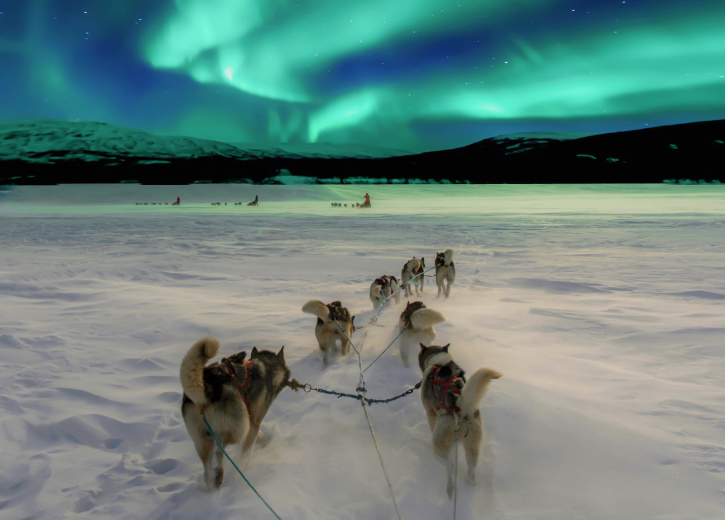
The sheer visual drama of a snow-covered wilderness under a dark winter sky, punctuated by the possibility of the Northern Lights appearing at any moment, creates a sustained sense of anticipation and wonder. This is not a passive backdrop; it is an active, changing environment that demands your full engagement. That quality of total immersion is precisely what makes Arctic travel experiences so emotionally resonant and so well-remembered.
Finnish Lapland, in particular, offers conditions that amplify this effect. Its vast, unspoiled landscapes, minimal light pollution, and deep seasonal silence create an environment where the ordinary rhythms of modern life simply do not reach. For travellers seeking the kind of experience that genuinely shifts perspective, that quality of disconnection from the everyday is not incidental — it is the point.
How does witnessing the Northern Lights affect the brain?
Witnessing the Northern Lights affects the brain by inducing a state of awe — a psychological response characterised by a sense of vastness that temporarily overwhelms normal cognitive frameworks. Research in the psychology of awe suggests this state reduces self-focused thinking, increases feelings of connection to something larger than oneself, and produces a measurable sense of well-being that can persist long after the experience ends.
Awe is one of the most psychologically powerful emotions humans can experience, and it is relatively rare in everyday life. The aurora borealis is one of the few natural phenomena that reliably triggers it, because it combines visual scale, movement, colour, and unpredictability in a way that the brain simply cannot process as routine. You cannot habituate to the Northern Lights the way you might habituate to a beautiful sunset — each display is genuinely different, and the uncertainty of whether it will appear at all intensifies the response when it does.
There is also a strong element of presence involved. Watching the aurora borealis requires you to be still, to look up, and to wait — behaviours that are naturally meditative. Many travellers describe the experience as one of the few moments in adult life when they felt completely absorbed in the present moment, which carries its own significant psychological value in an era of constant distraction.
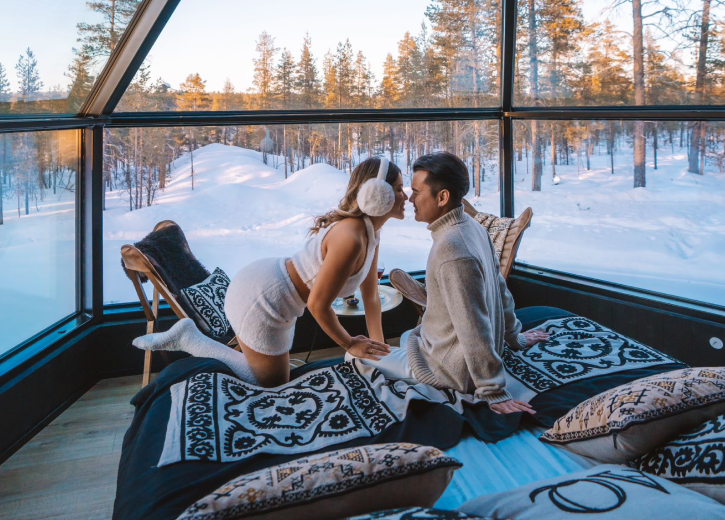
Staying in a glass igloo with a panorama ceiling, as we offer at Aurora Queen Resort, extends this experience in a way that intensifies its psychological impact. Rather than a brief outdoor sighting in the cold, guests can observe the lights for hours from the warmth of their own bed, allowing the awe response to deepen rather than being cut short by discomfort.
Why does remote, nature-based travel feel more restorative than city breaks?
Remote, nature-based travel feels more restorative than city breaks because natural environments reduce cognitive load in ways that urban settings cannot. Cities demand constant, directed attention — navigating traffic, processing noise, managing crowds. Wilderness environments, by contrast, engage what researchers call involuntary attention, a gentle, effortless form of awareness that allows the brain’s directed attention systems to recover.
This distinction, explored in attention restoration theory, helps explain why even a short period in a quiet natural environment can leave people feeling significantly more rested and mentally clear than the equivalent time spent in an urban setting. The effect is amplified in Arctic landscapes, where the absence of human noise and activity is particularly pronounced. The silence of a Finnish Lapland winter is not merely the absence of sound — it is an active quality that many travellers describe as physically palpable.
The role of sensory simplicity
Part of what makes Arctic wilderness so restorative is its sensory simplicity. The palette of colours is limited, the soundscape is minimal, and the absence of artificial light at night creates conditions that are genuinely rare in the modern world. This simplicity is not emptiness — it is a form of environmental clarity that allows the nervous system to downregulate in ways that are difficult to achieve elsewhere.
Wildlife and the restorative effect
Encounters with wildlife in their natural habitat add another layer to the restorative experience. Spotting a fox moving silently across the snow, or watching reindeer graze against a white horizon, triggers a form of quiet attention that is both calming and deeply engaging. These moments feel meaningful without requiring effort, which is precisely the quality that makes nature-based travel so effective at genuine rest.
What role does anticipation play in the bucket-list travel experience?
Anticipation plays a central role in the bucket-list travel experience because the psychological reward of a meaningful journey begins long before departure. Studies in behavioural economics and the psychology of happiness consistently show that people derive significant pleasure from looking forward to an experience, often reporting higher well-being during the planning phase than in the immediate aftermath of the trip itself.
This is particularly true for Arctic travel, where the planning process involves imagining genuinely extraordinary scenarios — will the Northern Lights appear? What will the silence actually feel like? How will it feel to wake up inside a glass igloo surrounded by snow? These imaginative rehearsals are not trivial; they are a form of emotional investment that makes the eventual experience feel even more significant when it arrives.
The element of natural unpredictability in Arctic travel also sustains anticipation in a way that more controlled holiday experiences cannot. Because the Northern Lights cannot be guaranteed, the possibility of witnessing them creates a low-level excitement that runs throughout the entire trip. Each clear evening carries potential, which keeps travellers emotionally engaged in a way that a pre-scheduled show or attraction simply cannot replicate.
For travellers planning a trip to Finnish Lapland in 2026, this anticipatory pleasure is worth embracing deliberately. Researching the science behind the aurora borealis, reading about the landscape, and choosing accommodation thoughtfully are not just practical steps — they are part of the experience itself.
How can travellers maximise the psychological reward of an Arctic trip?
Travellers can maximise the psychological reward of an Arctic trip by approaching it with intentional presence, realistic expectations about natural unpredictability, and a willingness to slow down. The greatest mistake is treating an Arctic journey like a conventional sightseeing holiday — rushing between activities and measuring success by a checklist. The deeper rewards come from allowing the environment to work on you gradually.
Choose accommodation that deepens immersion
Where you sleep matters enormously in the Arctic. Accommodation that places you in direct visual contact with the night sky and surrounding wilderness, such as a glass-ceiling igloo, means the restorative and awe-inducing qualities of the environment are present even during rest. This continuous immersion reinforces the psychological shift that makes Arctic travel genuinely transformative rather than simply memorable.
Balance structured activities with unstructured time
Guided experiences such as husky safaris, reindeer sleigh rides, ice fishing, and aurora hunting tours provide structure and expertise that genuinely enhance the trip. But the psychological research on restorative travel suggests that unstructured time in nature — simply sitting, walking, or watching — is equally important. Building quiet hours into your itinerary, especially in the evenings when the sky is darkest and the Northern Lights are most likely to appear, allows the deeper psychological benefits of Arctic travel to take hold.
The most rewarding Arctic journeys tend to be those where travellers arrive with curiosity rather than a rigid agenda, give themselves permission to be still, and stay long enough for the environment to feel genuinely familiar. In Finnish Lapland, that sense of belonging to a landscape so different from everyday life is itself one of the most powerful psychological gifts the Arctic has to offer.